How Grooms Can Match Outfits with the Bride
Matching the bride is not about wearing the same colour, it is about one shared accent and the same level of formality. Here is how couples coordinate well.
Coordinate, do not copy
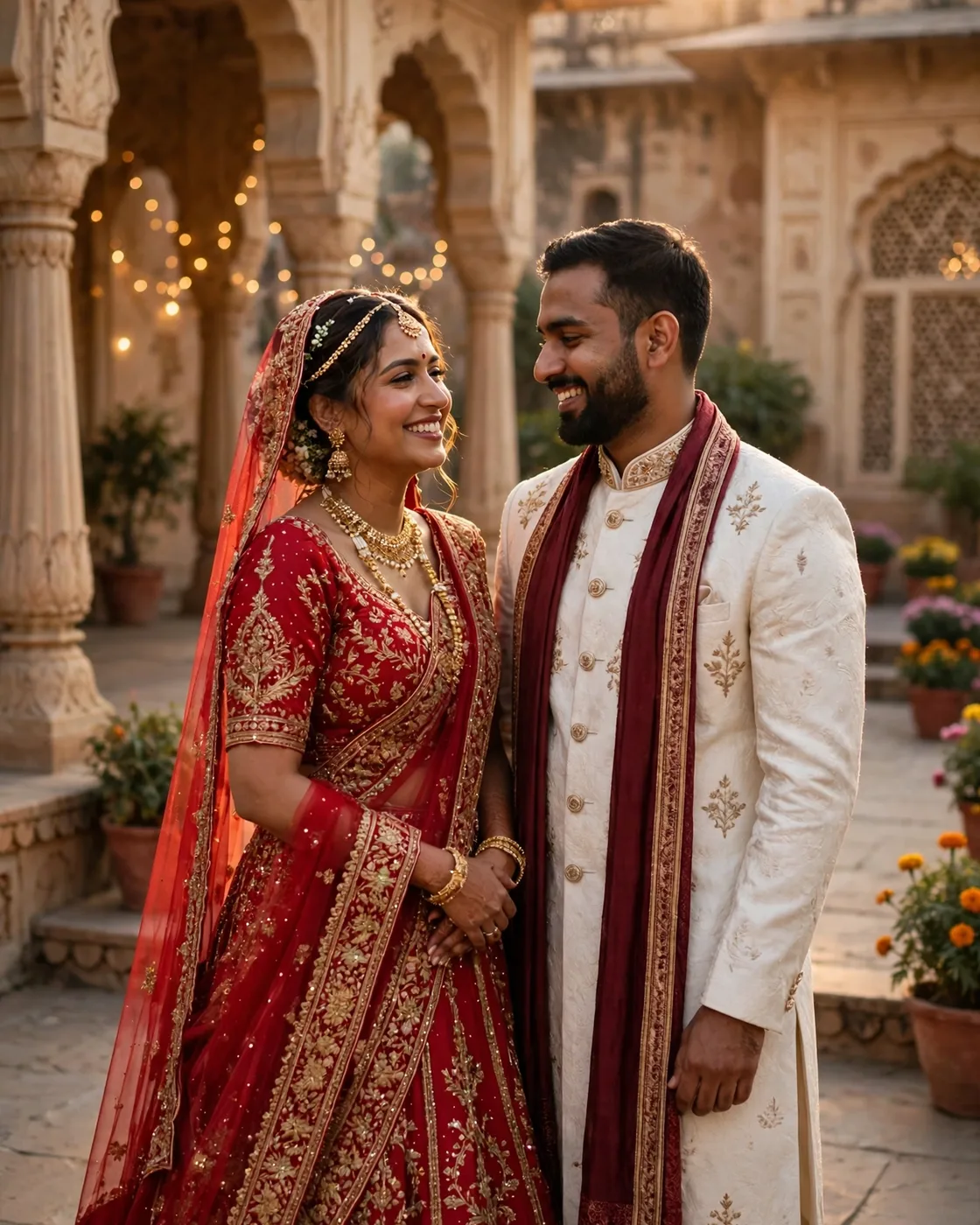
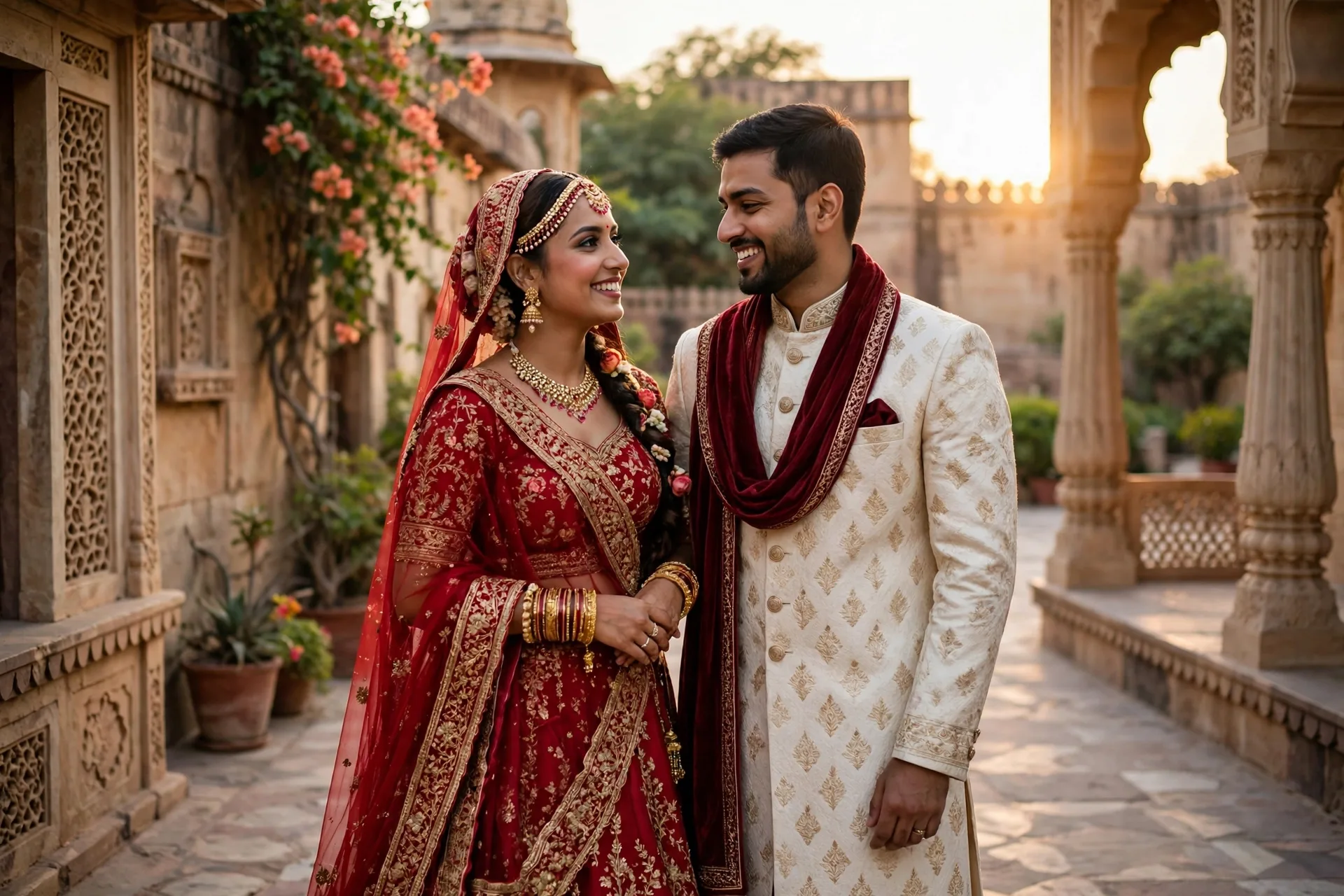
The best dressed couples at a wedding are not the ones in identical colours. They are the ones whose outfits sit in the same world: the same level of formality, the same warmth of colour, and one shared accent that links them. The groom in ivory with a maroon stole next to a bride in red looks coordinated. The groom in the exact same red as the bride looks like a matching set, and in photographs the couple blends into one block of colour.
The goal is a link, not a match. One colour, repeated once, in a stole, a pocket square, a brooch or a safa, is enough to say these two belong together. Everything else in the groom's outfit should be his own choice, suited to his skin, his body and his comfort.
Start with the bride's outfit
The bride's outfit usually comes first, because it is the more complex decision, and the groom's outfit should be chosen after it. Ask to see the bride's lehenga or saree, or at least a photograph of it in daylight, before you finalise your sherwani colour. A photograph in the shop is not enough: colours look different in daylight, under venue lights and on camera.
Look at the bride's main colour, her embroidery colour, and her jewellery. The groom's accent should come from one of those three, not from a fourth colour nobody else is wearing. If she wears red with gold embroidery, the groom can wear ivory with gold work and a maroon stole. If she wears pastel pink, he can wear cream with a pink pocket square.
Colour pairings that work
Ivory groom with a red bride is the classic pairing, and it works because the contrast is clean and the gold in both outfits links them. Burgundy groom with a red bride works when the burgundy is deep enough to read as a different colour, not a failed attempt at the same red.
Cream groom with a pastel bride works beautifully for daytime weddings, because both outfits are light and the photographs stay bright. Navy groom with a red or maroon bride works for evening weddings, because the dark groom balances the bright bride. Gold groom with a green bride is a traditional pairing that photographs richly, especially in silk.
Avoid the pairings that fight: emerald groom with a pink bride, bright yellow groom with a red bride, or two different pastels that have nothing in common. If the two outfits look like they belong to different weddings, one of them needs to change.
Formality should match too
Colour is only half the coordination. Formality is the other half. If the bride wears a heavily embroidered lehenga, the groom should wear a sherwani with real embroidery, not a plain kurta. If she wears a light, simple outfit for a daytime function, he should wear a light kurta set, not a heavy velvet sherwani.
This matters most across the functions. For haldi, she wears yellow and he wears yellow. For the sangeet, she wears something fun and he wears something fun. For the ceremony, she wears her finest and he wears his finest. The couple should always look like they are going to the same event, at the same level of dress.
The shared accent: stole, safa or pocket square
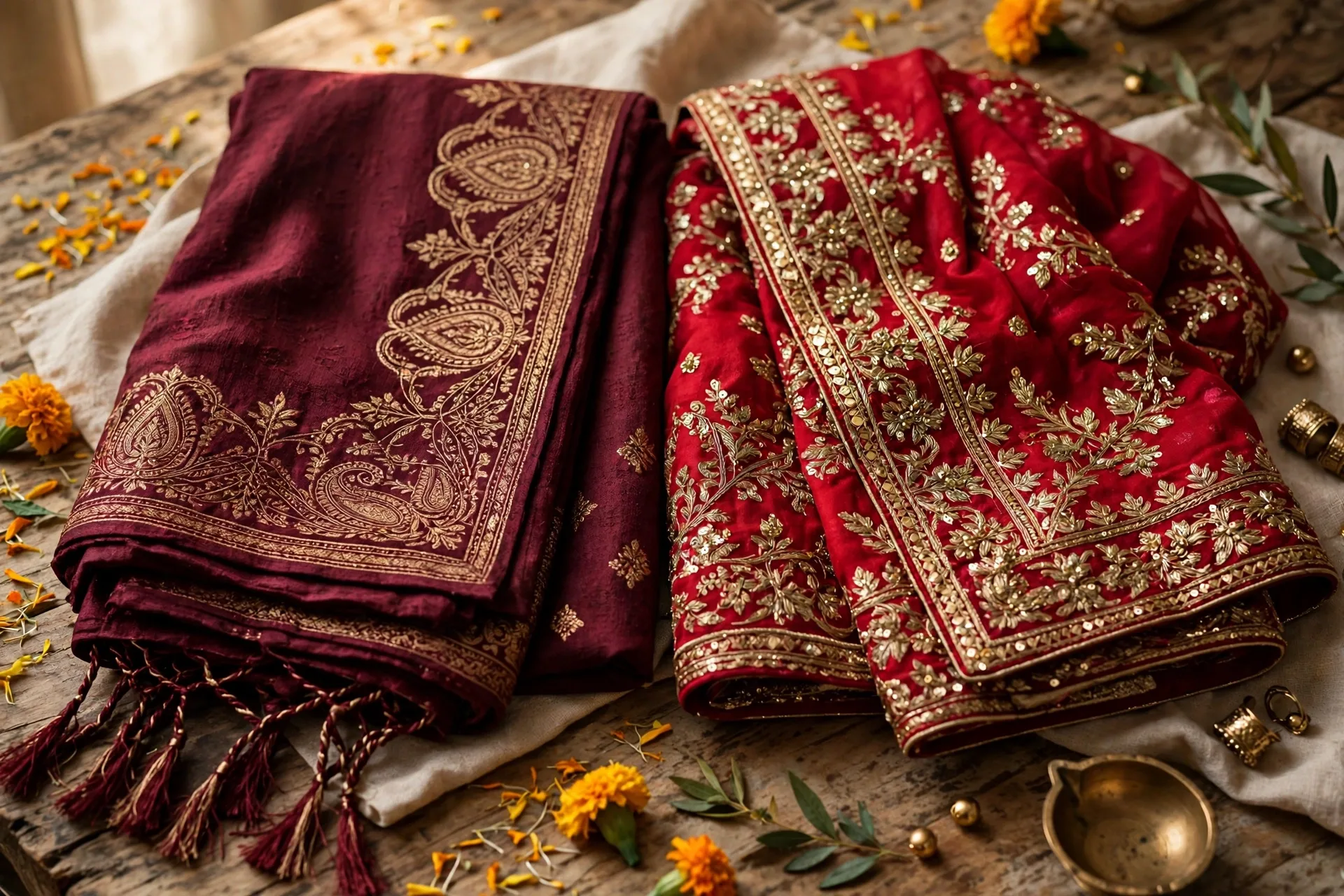
The shared accent is the practical tool for coordination. Choose one item on the groom that carries the bride's colour: the stole is the most visible, the safa is the most traditional, and the pocket square is the most subtle. One of them is enough. Two is fine if they are small. Three is too many.
The stole is the best choice for the ceremony, because it is large enough to read in photographs and it can be adjusted during the day. The safa is the best choice when the groom wears a turban, because it sits right next to his face. The pocket square is the best choice for the reception, where the groom wears a bandhgala and the stole would look out of place.
Try the outfits together
The single most useful thing a couple can do is try the two outfits on together, at least once before the wedding. Stand side by side in daylight, take a photograph, and look at it on a phone screen. The photograph will show in seconds what an hour of discussion cannot: whether the colours work, whether the formality matches, and whether the couple looks like a couple.
Do this at least two weeks before the wedding, so there is time to change a stole, a pocket square or a safa if the pairing is wrong. Changing the whole sherwani at the last minute is stressful and expensive. Changing one accessory is easy.
What it costs
Matching outfits does not need to cost extra. The shared accent, a stole, a pocket square or a safa in the bride's colour, typically costs between ₹1,000 and ₹5,000. Custom dyeing a sherwani to match the bride exactly costs more and takes longer, and it is usually unnecessary, because a shared accent does the job better than an exact match.
Frequently asked questions
Should the groom wear the exact same colour as the bride?
No. Coordinate, do not copy. One shared accent colour is enough. Exact matching looks staged in photographs and leaves no contrast between the couple.
What if the bride has not chosen her outfit yet?
Wait. The bride's outfit usually comes first, and the groom's colour should be chosen after it. Do not finalise the sherwani colour until you have seen the bride's outfit in daylight.
How do we match for haldi and mehndi?
For haldi, both wear yellow. For mehndi, the bride wears green and the groom wears green or a cream kurta with a green stole. These functions are the easiest to match, because the colours are traditional and fixed.
What if our families disagree on the colours?
Let the couple decide. The photographs are of the couple, and the couple has to feel good in the outfits. Families can advise on tradition, but the final pairing is the couple's call.
MyIndiAura theme showcase
These Cinematic Invites from MyIndiAura fit this wedding. Each one is ₹499.
- Rose Film: soft romance for a couple in coordinated colours.
- Gulab Dil: roses and warmth for a family celebration.
- Peony Bloom: fresh florals for a daytime wedding.
Related reading
- How to Choose the Perfect Wedding Invitation Theme
- Best Wedding Invitation Backgrounds and Colour Combinations
- Wedding Invitation Messages from Groom's Parents
One shared accent, the same level of formality, and one photograph together before the wedding. That is the whole secret.
Explore invitation designs
Choose a design and preview it free with your own names.
Found this useful? Share it with someone planning a celebration.
Share