Temple Jewellery Guide for South Indian Brides
Temple jewellery is the gold of South Indian weddings, inspired by temple carvings and gods. Here is how to choose a set that suits your saree and your ceremony.
How to choose temple jewellery
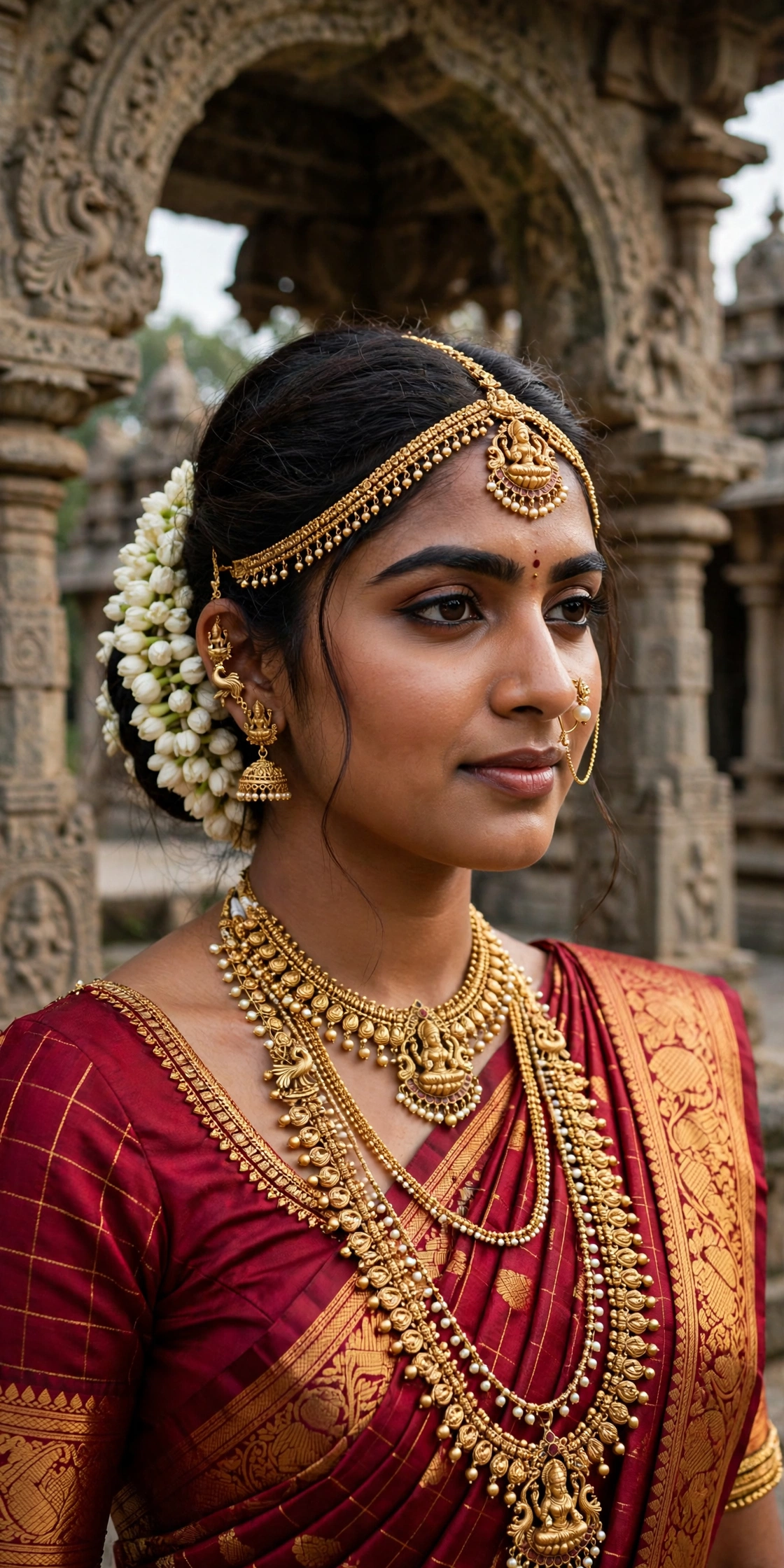
Temple jewellery is the gold of South Indian weddings. It takes its designs from temple carvings and the gods: Lakshmi, Ganesha, peacocks, lotuses, and mango motifs, all worked in gold with rubies, emeralds, and pearls. It is the jewellery that pairs with a Kanjivaram saree, jasmine flowers, and a neatly pleated drape, and it suits a bride who wants heritage, warmth, and a look that no modern jewellery can copy. The rule is simple: pick a temple set that suits your saree, your ceremony, and your comfort.
The haaram, the choker and the jhumkas
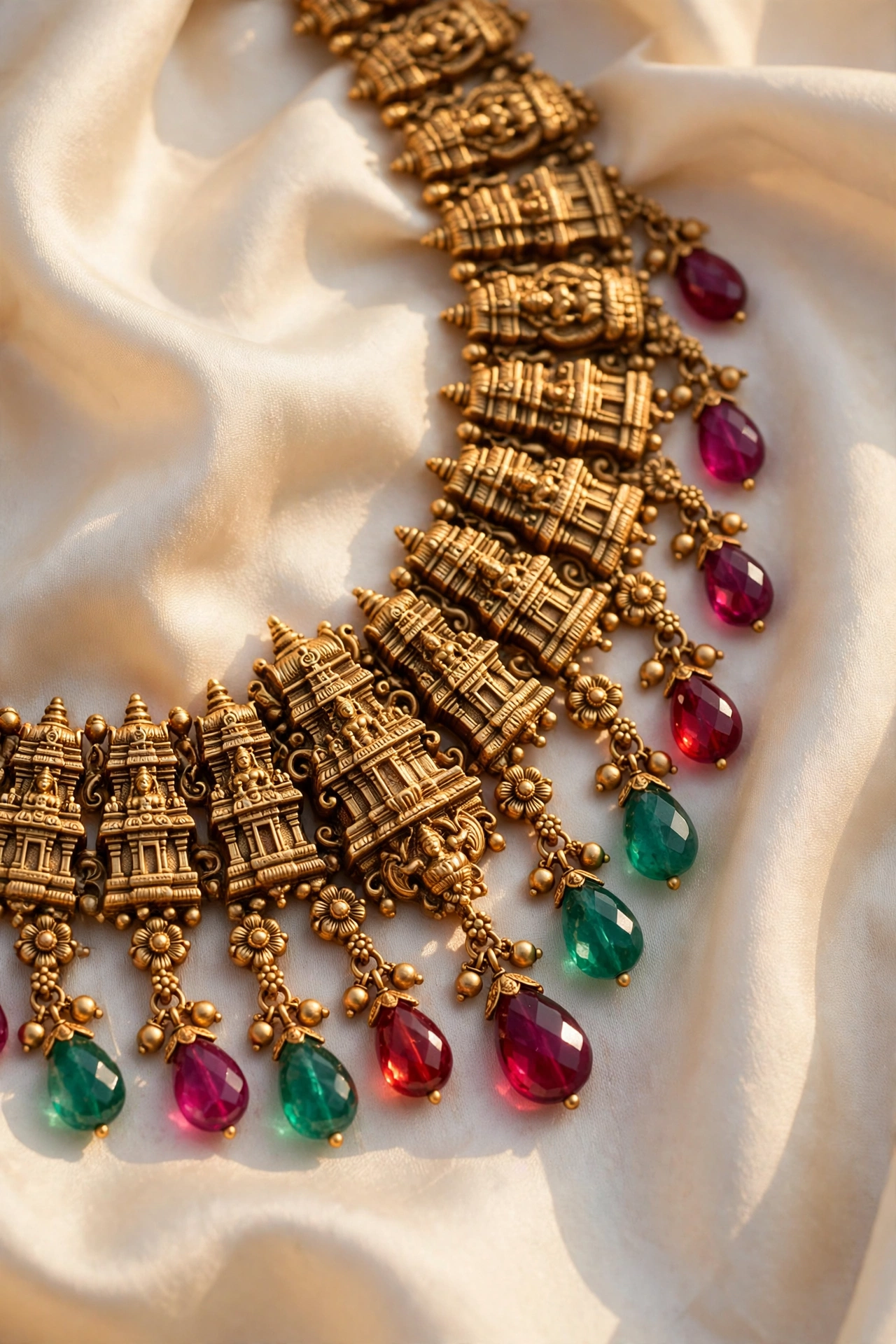
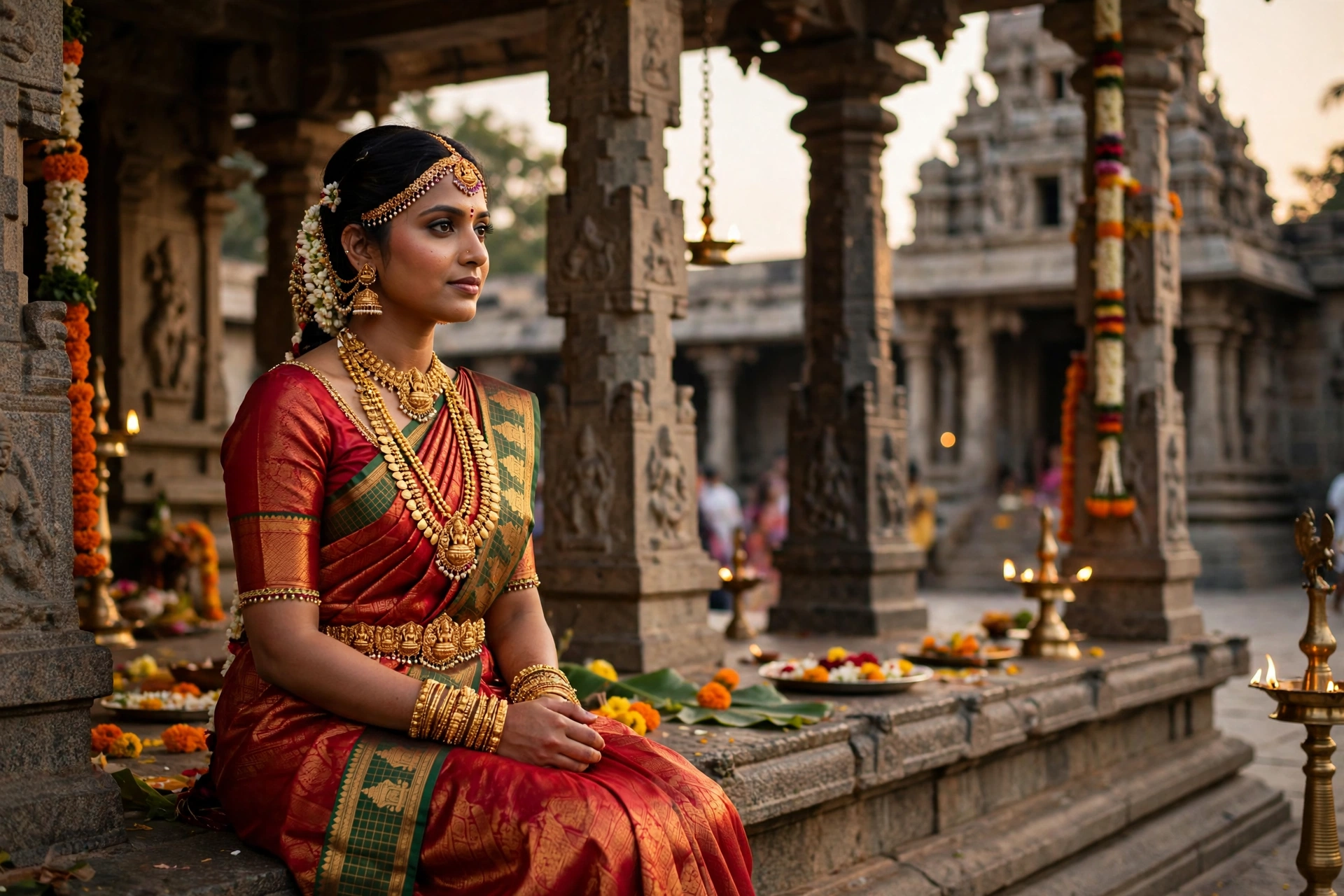
The haaram is a long temple necklace that falls to the waist, with a large Lakshmi or Ganesha pendant at the centre. It is the signature piece of temple jewellery, and it suits a Kanjivaram saree perfectly, because the long gold chain echoes the long drape. A haaram with ruby and emerald drops is the classic choice, and it photographs beautifully against a red or maroon saree. The choker is a shorter temple necklace that sits at the throat, with small temple motifs and a central pendant, and it frames the face.
Vanki, oddiyanam and the finishing pieces
The vanki is an armlet worn on the upper arm, with a temple motif in gold, and it is a signature South Indian piece. It suits a saree blouse with short sleeves, because it shows on the arm. The oddiyanam is a waist belt in gold, worn over the saree at the waist, with temple motifs and small bells. It is both decorative and practical, because it holds the saree drape in place. The maang tikka is a forehead ornament with a temple motif, and it ties the whole set together.
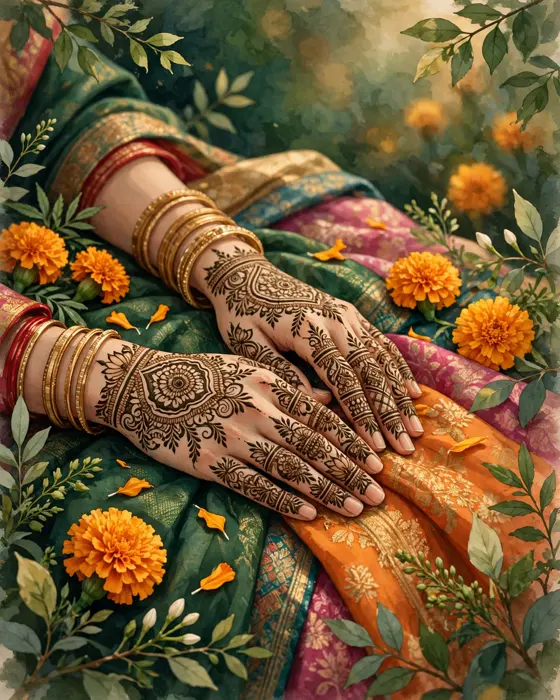
The nose ring, called a bullaku or a mookuthi, is worn by many South Indian brides, and it is a small, elegant piece that suits the temple set. Bangles are the final piece: gold bangles, sometimes with ruby and emerald stones, worn in a stack on both wrists. Keep the bangles comfortable, because you will wear them through hours of rituals. And keep the total weight in mind: a full temple set is heavy, so a lighter set with fewer pieces suits a long ceremony better than the full set.
Gold, rubies, emeralds and pearls
Temple jewellery is traditionally made in 22 karat gold, because the warm, rich gold suits the temple motifs. The gold is often finished with a matte or antique polish, which gives it the old temple look, rather than a bright, shiny polish. Rubies are the classic temple stone, because red suits the gold and the Kanjivaram saree. Emeralds are the second classic stone, because green contrasts beautifully with the gold and the red saree.
Pearls are the third classic partner, and a temple set with pearl drops is softer and more versatile than one with only coloured stones. Some temple sets mix all three: rubies, emeralds, and pearls, in a single haaram, for a truly royal look. When you choose the stones, match them to your saree, not to each other. A temple set with emerald drops will look wrong with a green saree, and a set with rubies will look wrong with a pink one. The jeweller can help you match the stones to the saree.
Matching temple jewellery to your saree and ceremony
Temple jewellery suits a Kanjivaram saree best, because the two share the same South Indian heritage. For the muhurtham, a full temple set with a haaram, choker, jhumkas, vanki, and oddiyanam is the classic bridal look, and it photographs beautifully in a temple or a hall. For the reception, a lighter temple set, with just the choker and jhumkas, suits a lighter saree or a lehenga, because it does not compete with a modern outfit.
For a daytime wedding, a temple set with pearls suits the soft light, because the uncut gold glows without glaring. For an evening wedding, a heavier temple set with rubies and emeralds suits the warm lights, because the coloured stones catch the light. And for a destination wedding, a minimal temple set, with just the choker and jhumkas, is the practical choice, because it travels well and suits a lighter saree. Whatever you choose, try the set with the saree, the blouse, and the jasmine flowers together, because the jewellery should sit on the fabric, not on bare skin.
Buying, caring and keeping temple jewellery safe
Buy temple jewellery from a trusted jeweller who specialises in South Indian gold, and ask for the hallmark certificate, which certifies the gold purity. Check the craftsmanship: the temple motifs should be crisp and detailed, not blurry or flat, because the detail is the whole point of temple jewellery. Check the setting of the stones: rubies and emeralds should sit securely, with no loose stones. Ask about the making charges and the exchange policy in writing, because temple jewellery is an investment and an heirloom.
What it costs
A temple jewellery set in 22 karat gold usually costs between ₹2,00,000 and ₹10,00,000, depending on the gold weight, the stones, and the craftsmanship. A smaller temple set, with just a choker and jhumkas, costs less, from about ₹75,000. A temple jewellery set in gold plated silver, for a bride who wants the look without the investment, costs from about ₹10,000 to ₹30,000. Set your budget before you shop, and remember that temple jewellery is an heirloom, worn for the wedding and for family occasions after, so durability and craftsmanship matter more than size.
The invitation is a fixed, small cost. On MyIndiAura, a Cinematic Invite is ₹499, an Invite App is ₹399, and an Invitation Suite is ₹99. Your temple jewellery photographs will look beautiful inside any of them. See the pricing page for the current prices.
How to create your temple jewellery invitation
- Pick a design that matches your wedding colours from the designs page at myindiaura.com/designs.
- Add your names, the ceremony dates and times, and the venue for each function.
- Add photographs of the couple, including one that shows the temple jewellery.
- Preview the invitation on your own phone, then share the link on WhatsApp. See myindiaura.com/create to start, and myindiaura.com/pricing for the full price list.
Details to check before you send
- The names of the bride and groom, spelt exactly as the families use them
- The date and time of each function, with the venue and the dress code
- A photograph that shows the wedding colours, so guests can plan their outfits
- The RSVP contact for guests who need directions or timings
- The temple jewellery hallmark, the certificate, and the jeweller's bill, kept safe
- A full hour trial of the temple set, with the saree you will wear
Frequently asked questions
What is temple jewellery?
Temple jewellery is South Indian gold jewellery inspired by temple carvings and the gods, with Lakshmi, Ganesha, peacock, lotus, and mango motifs, worked in gold with rubies, emeralds, and pearls. It is traditionally worn with a Kanjivaram saree.
Can I wear temple jewellery with a lehenga?
Yes. A temple choker and jhumkas suit a lehenga beautifully, because they add heritage to a North Indian outfit. Keep the haaram for the saree, and wear the lighter pieces with the lehenga.
How heavy is a full temple jewellery set?
A full set with haaram, choker, jhumkas, vanki, and oddiyanam is heavy, often over 300 grams of gold. Try the full set for an hour before the wedding, and choose a lighter set if the weight is uncomfortable.
MyIndiAura theme showcase
These Cinematic Invites from MyIndiAura fit this wedding. Each one is ₹499.
- Neelam Mandapam: a temple setting for temple jewellery.
- Deepa Tarang: lamps and temple tones for a South Indian bride.
- Nadavathil: Kerala temple tones for a traditional jewellery look.
Related reading
- Valaikappu: Tamil Bangle Ceremony Explained
- Hindu Wedding Invitation Wording and Traditions
- Indian Wedding Planning Checklist
Create your temple jewellery invitation on MyIndiAura, and let the invitation carry the gold of the temple to every guest.
Explore invitation designs
Choose a design and preview it free with your own names.

Found this useful? Share it with someone planning a celebration.
Share